(301) 220-6955
Columbia Town Center is the civic and commercial heart of one of the most intentionally designed communities in American urban planning history — a mixed-use district at the geographic center of Columbia, Maryland whose development reflects the founding vision of James Rouse and the Columbia Association’s half-century commitment to creating a planned city that balanced residential life, commercial activity, and public gathering in deliberate proportion.
Situated along Little Patuxent Parkway at the edge of Lake Kittamaqundi, the Town Center combines the Columbia Mall, the Merriweather Post Pavilion outdoor concert venue, the Howard County Library System’s Miller Branch, and the lakefront public spaces that give Columbia its most recognizable civic identity — making it the destination that Columbia residents, Howard County visitors, and anyone seeking the concentrated expression of what this planned community aspired to be are most likely to encounter first.
For Columbia residents, Howard County families, and anyone tracing the development of one of America’s most studied planned communities, the Town Center’s history and contemporary character offer an essential and revealing lens on what Columbia has become across more than five decades of continuous growth.
James Rouse and the Vision Behind Columbia’s Planning
Columbia’s founding vision traces directly to James Rouse — the Baltimore developer whose dissatisfaction with conventional suburban sprawl led him to assemble approximately 14,000 acres of Howard County farmland in the early 1960s and design a complete city from the ground up. Rouse’s planning philosophy — shaped by consultations with sociologists, psychologists, educators, and religious leaders as well as urban planners and architects — rejected the single-use zoning of conventional suburbia in favor of a mixed-use village system organized around the principle that physical design could actively support human community rather than merely accommodate it.
The Town Center was conceived as the urban core that would give Columbia’s nine villages a shared civic identity — the place where the planned city’s commercial, cultural, and civic functions would concentrate in the walkable, mixed-use format that Rouse believed American suburban development had abandoned. Development began in 1971 when the Columbia Mall opened — an enclosed shopping center whose design reflected the era’s retail preferences while serving the practical commercial needs of a rapidly growing planned community whose residential population was expanding faster than its retail infrastructure.
The Columbia Association documents Columbia’s founding history and James Rouse’s planning vision — the institutional record of how the Town Center’s mixed-use civic character evolved from the original planning principles that Rouse articulated in the late 1960s. The planned village character that Rouse embedded throughout Columbia is equally visible in neighborhoods like Hobbit’s Glen — one of Columbia’s most distinctive residential communities whose design reflects the same human-scaled planning philosophy that shaped the Town Center’s civic ambitions.
The Columbia Mall and Retail Evolution
The Columbia Mall — the enclosed shopping center that anchors the Town Center’s commercial core — has evolved across five decades of retail transformation from its 1971 opening through successive expansions, anchor tenant changes, and the ongoing adaptation to shifting consumer preferences that all American regional shopping centers have navigated since the rise of e-commerce began reshaping the retail landscape.
The mall’s current tenant mix reflects the national trend toward experience-oriented retail and food and beverage — the dining, entertainment, and service tenants that complement rather than compete with online shopping — alongside the traditional department store and specialty retail anchors that have defined regional mall formats since their postwar development.
The mall’s position within the Town Center’s mixed-use fabric gives it a civic function beyond pure retail — it serves as a climate-controlled gathering space for Howard County’s humid continental climate, providing the year-round indoor activity environment that outdoor public spaces cannot consistently deliver across Maryland’s full seasonal range.
Howard County’s summers routinely push temperatures above 90°F while winters deliver cold snaps and occasional snowfall, creating the seasonal weather variation that makes the mall’s indoor environment a genuine community amenity rather than merely a shopping destination.
Merriweather Post Pavilion and Cultural Programming
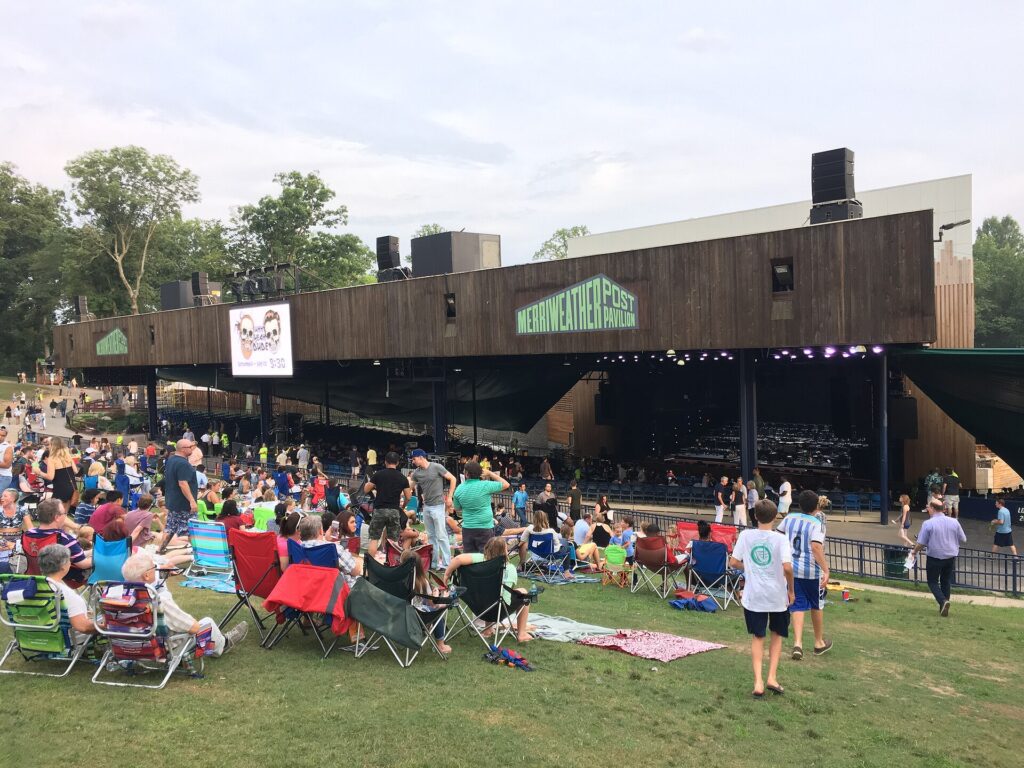
The Merriweather Post Pavilion — the outdoor concert venue that has operated within the Town Center since 1967, predating the mall and the broader commercial development of the area — represents Columbia’s most culturally significant contribution to the regional arts landscape and one of the most historically important outdoor music venues in the eastern United States.
Merriweather’s combination of covered pavilion seating and open lawn accommodation has made it the mid-Atlantic region’s premier outdoor concert destination across more than five decades of programming — hosting artists ranging from the Grateful Dead and Jimi Hendrix in its early years to contemporary headliners whose summer appearances define the regional concert calendar for Howard County and the broader Baltimore-Washington metropolitan area.
The venue’s 2017 and 2018 renovations — which replaced the original 1967 structures with new pavilion facilities while preserving the wooded setting and natural topography that give Merriweather its distinctive acoustic and atmospheric character — demonstrated the sustained investment in maintaining Columbia’s most culturally significant venue as a world-class outdoor performance space.
The Merriweather Post Pavilion maintains its own documentation of the venue’s history, programming philosophy, and renovation story — providing the institutional context for understanding how a 1967 outdoor venue has maintained its cultural relevance into the twenty-first century.
Lake Kittamaqundi and the Town Center’s Public Spaces
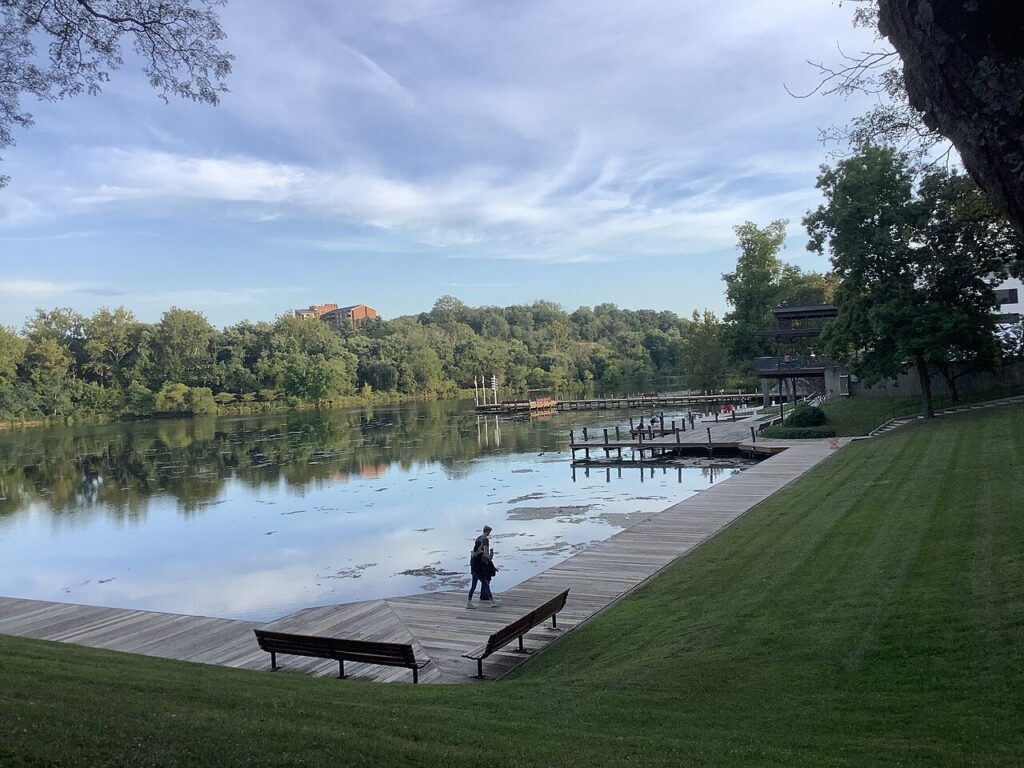
Lake Kittamaqundi — the man-made lake at the center of Columbia’s Town Center whose shoreline path, waterfront restaurants, and lakeside gathering spaces give the civic district its most humanly scaled and most beloved public character — represents the clearest physical expression of James Rouse’s conviction that water, open space, and pedestrian-scaled public realm were essential ingredients of successful community design.
The lake’s creation as part of Columbia’s original planning — damming a tributary of the Little Patuxent River to create the reflective water body that the Town Center’s restaurants and cultural facilities now orient toward — reflects the deliberate landscape architecture that distinguished Columbia’s planning from the more purely functional approach of conventional suburban development.
The lakefront path system — connecting the waterfront restaurants, the Jim Rouse Theatre for the Performing Arts, the Columbia Association headquarters, and the residential and commercial buildings that surround the lake — creates the pedestrian circulation network that gives the Town Center its walkable character on the days and seasons when Maryland’s climate cooperates.
According to NOAA climate data for the Columbia-Baltimore area, Columbia experiences average July highs near 88°F, average January lows near 25°F, and approximately 42 inches of annual precipitation — a humid continental climate whose spring and fall seasons create the most comfortable conditions for the outdoor lakefront activity that defines the Town Center’s most vibrant public life.
Lake Elkhorn Park offers a complementary lakefront experience elsewhere in Columbia — its recreational trails and natural setting reflecting the same design philosophy that placed Lake Kittamaqundi at the civic heart of the Town Center.
Columbia Town Center’s Role in Howard County’s Community Life
The Town Center’s significance to Columbia and Howard County extends beyond its commercial and cultural functions into its role as the physical embodiment of what Columbia’s planned community aspiration has achieved across five decades of development.
The concentration of retail, dining, entertainment, cultural programming, and public open space within a walkable, mixed-use district at the geographic center of a planned city represents a genuine achievement in American community development — one that has influenced urban planning practice, generated sustained academic study, and produced a community whose residents consistently express strong attachment to the place identity that the Town Center anchors.
The ongoing redevelopment of the Town Center — including new residential towers, expanded dining and entertainment options, and the continued evolution of the mall’s tenant mix toward the experience-oriented formats that contemporary retail demands — reflects the sustained investment in maintaining Columbia’s civic center as a relevant and vital destination for the next generation of Howard County residents. Columbia’s library network reinforces this community investment in accessible civic infrastructure — the East Columbia Library serves the eastern reaches of the planned community with the same commitment to accessible public resources that the Town Center’s cultural programming represents at the city’s center.
For Columbia residents, Howard County families, and anyone exploring the community character and commercial landscape of Columbia Maryland, the Town Center remains the most concentrated and most revealing expression of what James Rouse’s planned city vision has produced across more than half a century of continuous community building.